🔮 From Reactive to Predictive

    You find out too late., Forecast demand, catch fraud, prevent churn before it hits your P&L.

    Production-grade ML for demand, churn, fraud and quality, explainable, audit-ready, deployed inside your environment.

    The Problem

    Your forecasts are guesses. Your anomalies are caught after the loss.

    Reactive operations cost real money, in fraud written off, inventory sitting still, customers walking away. Predictive AI catches it before it hits the P&L.

    1
    Forecasts you can't plan against

    Demand planning runs on Excel and intuition. You over-stock the wrong SKUs, run out of the right ones, and finance can't trust the budget.

    2
    Fraud and risk caught too late

    Rules-based systems miss new patterns. By the time the loss shows up in a report, the money is already gone and the customer has already churned.

    3
    Pilots that never reach production

    Data scientists build models in notebooks that never get deployed, monitored, or retrained. The business never sees the value.

    Market signal

    What actually changed

    Specific observations from Saudi and GCC engagements and tenders, not generic predictions.

    Attention

    Generative AI is crowding out higher-return classic ML

    Executives are asking about the GenAI strategy far more than about forecast accuracy, and forecasting, churn and fraud programmes are losing budget to pilots with weaker returns. This is currently the most expensive misallocation we see in the region.

    Banking

    Model risk expectations tightened around fraud, AML and scoring

    Supervised institutions face heavier documentation, monitoring and explainability requirements. The bar being raised is evidence, not accuracy, a strong model without a model card and a drift dashboard will sit at the approval gate.

    Industry

    Predictive maintenance is more production-grade than most agentic pilots

    Across the Kingdom's industrial and energy base, condition monitoring and failure prediction are running at a maturity the newer AI categories have not reached. It remains one of the safest places to spend a first serious ML budget.

    Tooling

    MLOps and LLMOps are converging into one platform requirement

    The question moved on from whether you need a model registry to how classic models and language-model pipelines are governed side by side, with shared lineage, evaluation and monitoring rather than two parallel stacks.

    Our Solutions

    What We Deploy

    Enterprise-grade capabilities, deployed in Saudi Arabia and worldwide

    Demand Forecasting

    Predict sales, inventory needs, and resource requirements with high accuracy. Reduce overstock and stockouts.

    Fraud & Anomaly Detection

    Real-time ML models that catch fraud before it happens. Transaction scoring, behavioral analysis, network detection.

    Customer Churn Prediction

    Identify at-risk customers weeks before they leave. Trigger retention campaigns automatically.

    Recommendation Engines

    Personalized product, content, and service recommendations that increase basket size and engagement.

    Predictive Maintenance

    Forecast equipment failures before they happen using IoT sensor data. Reduce downtime and maintenance costs.

    Custom ML Models

    Bespoke models for your unique business problems, pricing optimization, risk scoring, demand sensing, NLP.

    Platform Showcase

    A Glimpse of Our Work

    Dashboards and interfaces we've built for enterprise clients worldwide

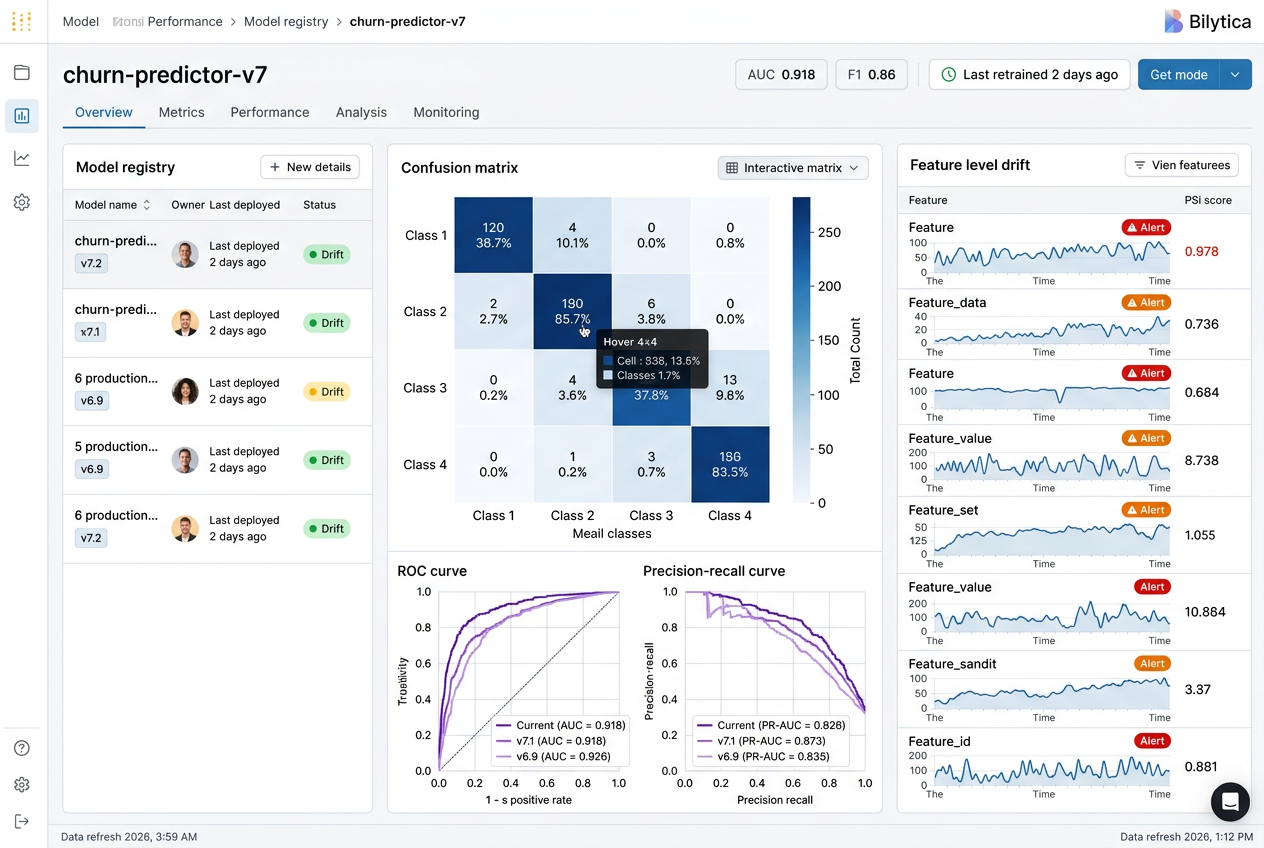
    ML Model Performance: Confusion Matrix & ROC Curves
    Click to enlarge

    ML Model Performance: Confusion Matrix & ROC Curves

    Process

    How We Deliver

    From assessment to measurable ROI in weeks, not months

    01

    Problem Framing

    Define the business question, success metrics, and available data. We solve business problems, not science experiments.

    02

    Data Preparation

    Feature engineering, data cleaning, and dataset creation. This is where 80% of model quality comes from.

    03

    Model Development

    Train, validate, and benchmark multiple algorithms. Explainable AI, we show you WHY the model predicts.

    04

    Production & MLOps

    Deploy with monitoring, drift detection, automated retraining, and A/B testing. Models that get smarter over time.

    Use Cases

    Deployed Across Industries

    Proven results in every major sector

    Banking

    Credit scoring, fraud detection, AML transaction monitoring, and loan default prediction

    Retail

    Demand forecasting, dynamic pricing, personalization engines, and basket analysis

    Oil & Energy

    Predictive maintenance for drilling equipment, production optimization, and price forecasting

    Healthcare

    Disease risk prediction, readmission forecasting, and treatment outcome optimization

    Manufacturing

    Quality prediction, yield optimization, predictive maintenance, and supply chain forecasting

    Telecom

    Churn prediction, network capacity planning, and customer lifetime value modeling

    Technologies & Platforms

    The platforms we build on

    Every platform here is a 2026 Gartner Magic Quadrant Leader or category standard, so your stack stays current, defensible, and future-proof.

    ML Platforms

    Databricks Mosaic AIDatabricks Mosaic AI
    Azure AI FoundryAzure AI Foundry
    Vertex AIVertex AI
    Amazon SageMakerAmazon SageMaker

    Frameworks

    TensorFlowTensorFlow
    PyTorchPyTorch
    Scikit-learnScikit-learn
    XGBoostXGBoost

    Generative AI

    OpenAIOpenAI
    Anthropic ClaudeAnthropic Claude
    Meta Llama 3Meta Llama 3
    Hugging FaceHugging Face

    MLOps & Lifecycle

    MLflowMLflow
    KubeflowKubeflow
    Weights & BiasesWeights & Biases
    Vertex AI PipelinesVertex AI Pipelines

    Vector & RAG

    PineconePinecone
    pgvectorpgvector
    Databricks VectorDatabricks Vector
    QdrantQdrant

    Explainability

    SHAPSHAP
    LIMELIME
    Azure Responsible AIAzure Responsible AI
    Vertex Explainable AIVertex Explainable AI
    How the work is structured

    How a model reaches a business decision

    1

    Decision framing

    • The action the model changes
    • Cost of a wrong call
    • Owner of the response
    2

    Features

    • Governed, reusable inputs
    • Point-in-time correctness
    • Documented sourcing
    3

    Modelling

    • Baseline before complexity
    • Backtesting on real history
    • Explainability for review
    4

    Operation

    • Monitoring for drift
    • Scheduled retraining
    • Fallback when confidence drops
    Live outcomes feed back into features and retraining.
    Selected work

    Work we have delivered

    Client identities are withheld. The situations, the build and the change afterwards are as they happened.

    Demand planning

    A Gulf distributor

    The situation
    Planning ran on a spreadsheet consensus that quietly absorbed everyone's safety margin.
    What we built
    A forecasting baseline on real history, with planner overrides recorded and measured against outcomes.
    What changed
    Planners argue about the exceptions rather than rebuilding the forecast every cycle.

    Early risk signals

    A Saudi lender

    The situation
    Deterioration in accounts surfaced only at the point of formal review.
    What we built
    A scored early-warning model with explanations attached to every flag for credit review.
    What changed
    Cases reach the review team while intervention is still an option.

    Churn response

    A regional operator

    The situation
    A churn model existed but nobody owned what happened after a customer was flagged.
    What we built
    Scores wired into the retention workflow with a defined action per risk band.
    What changed
    The prediction now triggers work instead of sitting in a dashboard.

    Where we are strongest

    We treat a prediction as unfinished until it changes an action.

    The decision comes first

    Every engagement starts from the action being made today and who owns it, which is what prevents an accurate model nobody uses.

    Right model for the data

    Structured forecasting stays with methods that win on accuracy and cost; language models are used where unstructured signal or explanation is the job.

    Explanations built for reviewers

    Outputs carry reasons a credit or risk reviewer can act on, because unexplained scores stall in exactly that meeting.

    Designed to degrade safely

    Drift monitoring and a defined fallback mean the process keeps running when the model stops being right.

    Inspiring Case Study

    Transformed International Retail Group with Analytics

    Featured Success Story
    “Bilytica's demand forecasting model significantly reduced our inventory waste in the first year. We now predict with high accuracy what each store needs, daily.”
    International Retail Group
    Retail: Stores across MENA & Europe
    Major inventory savings
    SDAIA AlignedVision 2030PDPL · NDMONCA ECCSAMA Ready

    Built for Vision 2030, AI the Kingdom's regulators recognize.

    Every Bilytica AI solution is engineered for the Saudi governance stack: SDAIA Generative AI controls, PDPL data-subject rights supervised by the NDMO, NCA ECC cybersecurity, and sector frameworks from SAMA, CST, MoH and Etimad. Workloads stay inside Saudi data borders on STC Cloud, Mobily, Oracle KSA or Microsoft Saudi regions, with evidence packs ready for audit on demand.

    SDAIA AI Society partner
    Aligned with the National Strategy for Data & AI led by SDAIA, Generative AI guidelines applied to every deployment.
    Vision 2030
    Built around Vision 2030 priorities: digital government, sovereign cloud, Saudization of AI talent and an in-Kingdom data economy.
    PDPL · NDMO
    Personal Data Protection Law controls supervised by the NDMO, data-subject rights, lineage and DPIAs ready out of the box.
    NCA ECC + SAMA
    Essential Cybersecurity Controls from the NCA plus SAMA cyber + outsourcing frameworks, evidence packs generated continuously.
    From live tenders

    What buyers are asking us

    The questions that come up in almost every vendor evaluation, answered straight.

    “Should we use a language model for demand forecasting?”

    No. For structured, history-rich forecasting, gradient-boosted trees and modern time-series models still win on accuracy and cost by a wide margin. Language models earn their place explaining a forecast or reading unstructured demand signals, not producing the number.

    “Our churn model scores well but retention hasn't moved. Why?”

    Because a score is not an intervention. The usual failure is a model with no operational workflow behind it, ask what happens in the 48 hours after a high-risk flag fires, and if nobody can answer, fix that before touching the algorithm.

    “What will the regulator expect for an AI-driven fraud or AML model?”

    Explainability, human override, fairness testing and continuous performance monitoring, documented to model-risk standards. A vendor who cannot produce a model card and a drift dashboard out of the box will add months to your approval timeline.

    “Can generative AI improve fraud detection?”

    On the investigation side, summarising case evidence and triaging alerts for analysts, genuinely yes. As a replacement for anomaly scoring, no, and that claim should make you sceptical of the rest of the pitch.

    “How much of our forecasting problem is really a data problem?”

    Most of it. Inconsistent product master data and missing promotional and event calendars explain poor accuracy far more often than model choice does. Fix the inputs before buying a better algorithm.

    “How do we know when a model has gone stale?”

    By monitoring input distribution and outcome quality on a schedule, with a documented threshold that triggers retraining. Waiting for the business to complain means you found out from your customers.

    FAQ

    Frequently Asked Questions

    Common questions about You find out too late., Forecast demand, catch fraud, prevent churn before it hits your P&L..

    How is predictive AI different from generative AI?

    Predictive AI forecasts a number or a class, demand next month, fraud risk on this transaction, churn probability for this customer. Generative AI produces new content. We use both, but for measurable business outcomes (cost ↓, revenue ↑, risk ↓) it's predictive models that move the P&L most reliably.

    How much data do we need to train a useful model?

    Less than most teams think. For demand forecasting and churn we typically need 18–24 months of clean transactional history per entity. For fraud and anomaly detection, even 6 months of labelled events is enough to outperform a rules engine. Our first sprint is a data feasibility check, we tell you honestly if the data isn't there yet.

    How do you avoid model drift in production?

    Every model ships with MLOps from day one, Databricks MLflow or Azure ML for the registry, automated monitoring for input drift, prediction drift and performance decay, and scheduled retraining tied to data freshness. If a model degrades, the on-call team is paged, not the business.

    Can you explain why the model made a prediction?

    Yes. We use SHAP, LIME and built-in explainability from Databricks, Azure ML and Vertex AI. Every prediction comes with the top 3–5 drivers, essential for credit, AML, healthcare and any regulated decision under PDPL, GDPR or sector rules.

    Where do the models run, cloud or on-prem?

    Both. Models train on Databricks Mosaic AI, Azure AI Foundry, Vertex AI or Amazon Bedrock and are served via the same platform, or exported to ONNX / TorchServe for fully on-prem inference inside your data centre. Same model, same accuracy, your choice of runtime.

    What ROI should we expect from a first ML use case?

    Our first production use cases typically pay back inside 6–9 months, 20–40% reduction in fraud losses, 25–35% reduction in customer churn on targeted segments, or 15–25% reduction in inventory waste. We agree the success metric and the baseline before we start, so ROI is provable, not anecdotal.
    Get a Free Predictive AI Feasibility Assessment

    Our ML engineers will analyze your data, identify the highest-ROI prediction use case, and deliver a proof-of-concept, free of charge.

    Call +966 54 597 3047

    🔒 No obligation · Free assessment · Results in 2 weeks