⚙️ The Foundation of Every AI Initiative

    Reports take weeks., Trusted data refreshed in minutes, on one governed lakehouse.

    Modern lakehouse on Databricks, Snowflake or Microsoft Fabric, built for sovereignty, scale and the speed your business actually moves at.

    The Problem

    Your data is scattered, late, and untrusted, and every report takes weeks.

    Behind every late dashboard and every failed AI pilot is the same broken foundation. Modern data engineering is the fix decision-makers feel within one quarter.

    1
    Data lives in silos

    ERP, CRM, billing, IoT, spreadsheets, nothing reconciles. Finance, ops and the board each see a different number for the same KPI.

    2
    Reports take weeks, not minutes

    Every new metric is a ticket. Analysts spend their days copy-pasting from extracts instead of answering business questions.

    3
    AI projects stall on bad data

    Models can't be trained, audits can't be passed, and forecasts can't be trusted, because the underlying pipelines are fragile and undocumented.

    Market signal

    What actually changed

    Specific observations from Saudi and GCC engagements and tenders, not generic predictions.

    Platform

    Fabric became the default safe choice inside Microsoft estates

    It arrives inside the enterprise agreement and inside an in-Kingdom region, so it clears procurement before engineering has finished evaluating it. That is an accurate description of how the decision is being made, not an argument that it is always the right engine.

    Residency

    Cross-border lakehouse compute is the live friction point

    Databricks depth in the region is strong, but many Saudi workloads still execute in neighbouring cloud regions. For PDPL-sensitive data that becomes an architecture problem discovered late, usually after the platform has been selected.

    Migration

    Legacy warehouse and SAS displacement is being bundled with compliance work

    Licensing pressure alone rarely funds a migration. NDMO classification and PDPL obligations force a re-architecture of the estate anyway, so the two budgets are being merged into a single programme in banking and government.

    Streaming

    Most "real-time" requirements are near-real-time in disguise

    Telco and smart-city tenders ask for streaming; the underlying business need is usually minutes, not milliseconds. Building true streaming where micro-batch would do is one of the more expensive mistakes in this discipline.

    Our Solutions

    What We Deploy

    Enterprise-grade capabilities, deployed in Saudi Arabia and worldwide

    Sovereign Data Lakehouse

    Unified analytics + AI on one platform. Delta Lake / Iceberg on Saudi cloud. Query structured and unstructured data together.

    Real-Time ETL/ELT Pipelines

    Stream processing with Kafka, Spark Streaming, and Flink. Sub-second data from source to insight.

    Data Mesh Architecture

    Domain-owned data products with self-serve infrastructure. Break the central bottleneck without losing governance.

    Data Lineage & Cataloging

    Know where every data point comes from, who changed it, and where it flows. Full audit trail for NDMO compliance.

    Master Data Management

    Single source of truth for customers, products, and assets. Deduplication, matching, and golden record creation.

    Cloud & On-Prem Hybrid

    Deploy on AWS, Azure, GCP, or on-prem Saudi infrastructure. Multi-cloud strategy with unified management.

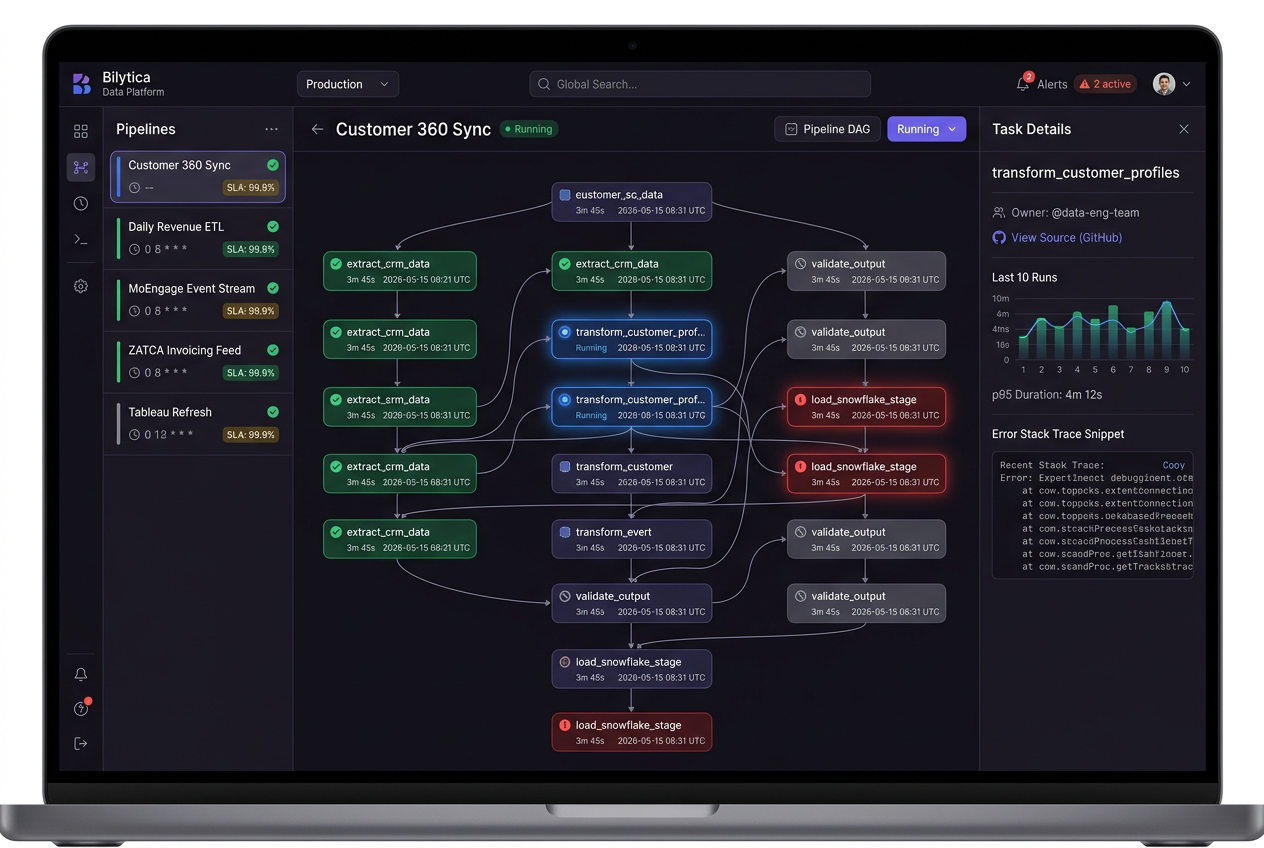
    Platform Showcase

    A Glimpse of Our Work

    Dashboards and interfaces we've built for enterprise clients worldwide

    Data Pipeline Monitoring & Workflow Platform
    Click to enlarge

    Data Pipeline Monitoring & Workflow Platform

    Process

    How We Deliver

    From assessment to measurable ROI in weeks, not months

    01

    Data Assessment

    Audit current data sources, quality scores, pipeline architecture, and governance gaps

    02

    Architecture Design

    Design lakehouse, pipeline topology, and governance framework tailored to your scale

    03

    Build & Migrate

    Implement pipelines, migrate data, set up monitoring, and validate quality gates

    04

    Operate & Optimize

    24/7 monitoring, auto-scaling, cost optimization, and continuous quality improvement

    Use Cases

    Deployed Across Industries

    Proven results in every major sector

    Banking

    Real-time fraud detection pipelines processing high-volume transactions with sub-second alerting

    Oil & Energy

    IoT sensor data lakes ingesting millions of events daily from drilling and refinery operations

    Government

    National data platforms consolidating ministry data silos with NDMO-compliant governance

    Healthcare

    Patient data integration across clinics with enterprise-grade encryption and lineage

    Telecom

    CDR processing pipelines handling large record volumes daily for real-time network analytics

    Retail

    Unified customer 360 from POS, e-commerce, loyalty, and social data in real-time

    Technologies & Platforms

    The platforms we build on

    Every platform here is a 2026 Gartner Magic Quadrant Leader or category standard, so your stack stays current, defensible, and future-proof.

    Cloud Data Platforms

    DatabricksDatabricks
    SnowflakeSnowflake
    Microsoft FabricMicrosoft Fabric
    Google BigQueryGoogle BigQuery

    Lakehouse & Storage

    Delta LakeDelta Lake
    Apache IcebergApache Iceberg
    Amazon S3Amazon S3
    Azure Data LakeAzure Data Lake

    Ingestion & ELT

    FivetranFivetran
    InformaticaInformatica
    AirbyteAirbyte
    IBM DataStageIBM DataStage

    Streaming

    Apache KafkaApache Kafka
    ConfluentConfluent
    Apache SparkApache Spark
    Apache FlinkApache Flink

    Transformation & Orchestration

    dbtdbt
    Apache AirflowApache Airflow
    Azure Data FactoryAzure Data Factory
    AWS GlueAWS Glue

    Quality & Observability

    Great ExpectationsGreat Expectations
    Monte CarloMonte Carlo
    Microsoft PurviewMicrosoft Purview
    OpenLineageOpenLineage
    How the work is structured

    How the data foundation is layered

    One control plane for access, cost and data quality across every layer.

    Sources

    Core and line-of-business systemsFiles and external feedsStreams and events

    Ingestion

    Declarative pipelinesSchema and contract checksReplay on failure

    Model

    Conformed business entitiesTested transformationsDocumented lineage

    Serving

    Analytics and reportingFeature and model accessGoverned sharing
    Selected work

    Work we have delivered

    Client identities are withheld. The situations, the build and the change afterwards are as they happened.

    Group platform

    A Saudi holding group

    The situation
    Each subsidiary reported from its own extracts, so the board reviewed numbers that never reconciled.
    What we built
    A single ingestion and modelling layer with conformed entities and lineage published to the business.
    What changed
    Group reporting comes from one modelled source and reconciliation meetings ended.

    Operational data

    A logistics operator

    The situation
    Overnight batch loads meant operations acted on a picture of the previous day.
    What we built
    Event-based ingestion for the movement-critical domains with the batch estate left where batch is correct.
    What changed
    Dispatch and exception handling work against current state instead of yesterday's file.

    Migration off legacy

    A government programme office

    The situation
    A legacy warehouse carried undocumented logic that nobody was willing to switch off.
    What we built
    Logic was recovered into tested, version-controlled transformations and run in parallel until outputs matched.
    What changed
    The legacy estate was retired without a reporting gap during the cutover.

    Where we are strongest

    We build platforms that survive the third year, not just the first release.

    Modelling before tooling

    Conformed business entities are agreed with the people who own the numbers, which is what stops the next round of shadow extracts.

    Pipelines that fail loudly

    Contract checks, replay and alerting are part of the build, so a broken load is caught before it reaches a report.

    Cost as a design constraint

    Storage tiering, workload isolation and query patterns are decided during design rather than after the first surprising invoice.

    Residency-aware architecture

    Where data physically lives is treated as an architectural input, so in-Kingdom requirements do not force a redesign later.

    Inspiring Case Study

    Transformed Global Energy Corporation with Analytics

    Featured Success Story
    “Bilytica rebuilt our entire data infrastructure in weeks. We went from lengthy batch jobs to real-time dashboards. Our data team now spends the majority of time on innovation instead of firefighting.”
    Global Energy Corporation
    Oil & Gas: Middle East & North America
    Dramatic efficiency gains
    SDAIA AlignedVision 2030PDPL · NDMONCA ECCSAMA Ready

    Built for Vision 2030, AI the Kingdom's regulators recognize.

    Every Bilytica AI solution is engineered for the Saudi governance stack: SDAIA Generative AI controls, PDPL data-subject rights supervised by the NDMO, NCA ECC cybersecurity, and sector frameworks from SAMA, CST, MoH and Etimad. Workloads stay inside Saudi data borders on STC Cloud, Mobily, Oracle KSA or Microsoft Saudi regions, with evidence packs ready for audit on demand.

    SDAIA AI Society partner
    Aligned with the National Strategy for Data & AI led by SDAIA, Generative AI guidelines applied to every deployment.
    Vision 2030
    Built around Vision 2030 priorities: digital government, sovereign cloud, Saudization of AI talent and an in-Kingdom data economy.
    PDPL · NDMO
    Personal Data Protection Law controls supervised by the NDMO, data-subject rights, lineage and DPIAs ready out of the box.
    NCA ECC + SAMA
    Essential Cybersecurity Controls from the NCA plus SAMA cyber + outsourcing frameworks, evidence packs generated continuously.

    What is data transformation and why does my business need it?

    Data transformation is the process of converting raw, scattered data from ERP, CRM, IoT and SaaS sources into clean, governed, analytics-ready datasets in a modern lakehouse (Databricks, Snowflake or Microsoft Fabric). Enterprises need it because reporting takes weeks, KPIs disagree across departments, and AI models fail on fragmented data. Done right, it cuts pipeline run time by 60–80%, gives finance, ops and the board one source of truth, and unlocks AI/ML on trusted, sovereign data.

    • Unifies ERP, CRM, billing, IoT and spreadsheets into one governed lakehouse.
    • Replaces multi-week reporting cycles with near real-time refreshes.
    • Enforces NDMO, PDPL and SAMA-aligned governance from day one.
    • Foundational layer for every AI, ML and agentic-AI use case.
    From live tenders

    What buyers are asking us

    The questions that come up in almost every vendor evaluation, answered straight.

    “Can our data genuinely stay in-Kingdom end to end?”

    Check control planes, telemetry and support logs, not just primary storage. Most residency claims cover the data plane only, and metadata frequently leaves the Kingdom unless the architecture explicitly prevents it. Get that in writing before selection.

    “Fabric or Databricks?”

    Deep Microsoft footprint with BI-centric workloads points to Fabric on friction and cost. Serious data science, multi-cloud ambitions or demanding catalog governance point to Databricks. What matters most is not letting an incumbent licensing relationship silently decide an architecture question.

    “What will ingestion actually cost at scale?”

    Nobody can tell you until the query and compute pattern is fixed. Cost is dominated by small-file handling and idle interactive clusters, not storage, carry meaningful contingency over the vendor's sizing for year one and put cluster policies in place on day one.

    “Can we retire our SAS estate this year?”

    Reporting and exploratory workloads, usually yes. The blocker is regulatory model logic buried in macros nobody has documented, credit risk and AML scoring especially. Budget a discovery and reverse-engineering phase rather than a lift and shift.

    “Do we still need a separate warehouse alongside the lake?”

    For most enterprises of your size, no, a single lakehouse genuinely replaces the two-tier design. The exception is legacy BI tooling with hard dependencies on classic SQL semantics, and that is a reason to plan the tool migration, not to keep the warehouse forever.

    “Why do our pipelines keep breaking when a source system changes?”

    Because schema drift is being handled by an alert instead of a contract. Put an explicit contract and a quarantine path on every ingestion route, and a source change becomes a ticket rather than a Sunday outage.

    FAQ

    Frequently Asked Questions

    Common questions about Reports take weeks., Trusted data refreshed in minutes, on one governed lakehouse..

    What exactly is data transformation and why does my business need it?

    Data transformation cleans, joins, governs and reshapes raw operational data into trusted, analytics-ready datasets on a modern lakehouse. Without it, KPIs disagree, dashboards lag by weeks and AI models fail. With it, finance, ops and the board work from one source of truth and new use cases ship in days, not quarters.

    How is data transformation different from ETL/ELT and data integration?

    Data integration moves data between systems. ETL/ELT extracts and loads it. Data transformation is the 'T' done well, applying business rules, joins, deduplication, conformance and quality tests so the output is usable for analytics and AI. In a modern lakehouse, transformation is code-defined in dbt or Spark, versioned in Git, tested with Great Expectations, and observable end-to-end.

    Should we build an in-house data pipeline or hire a specialist consultancy?

    In-house works once you have a senior data platform team, an architect, an SRE on-call rotation and 12+ months of runway. Specialist consultancies compress time-to-value to weeks, bring 2026 reference architectures already proven across banking, energy and government, and transfer knowledge so your team owns the platform after go-live. The hybrid model, consultancy builds, in-house operates, is what most Saudi enterprises now choose.

    What's the typical ROI timeline for a data transformation project?

    Most enterprises see a working production slice within 8–12 weeks, hard cost savings (30–50% lower cloud spend, 60–80% faster pipelines) within 6 months, and full payback within 9 months. Revenue impact, faster product launches, better pricing, lower churn, typically materializes in the second and third quarter once business teams trust the data.

    What tools and technologies do you use (Databricks, Snowflake, Azure, AWS, GCP)?

    We are platform-agnostic across 2026 Magic Quadrant Leaders: Databricks, Snowflake and Microsoft Fabric for the lakehouse; AWS, Azure and GCP for cloud; Informatica, Fivetran, dbt, Airflow, Kafka and Flink for ingestion, transformation and streaming; Great Expectations, Monte Carlo and Purview for quality and lineage. Choice is driven by your existing estate, sovereignty rules and TCO, not vendor preference.

    How do you handle real-time vs. batch data transformation?

    One unified platform handles both. Spark Structured Streaming, Kafka/Confluent and Flink power sub-second use cases (fraud detection, IoT, recommendations), while scheduled batch jobs in dbt or Airflow run finance, regulatory and historical analytics. Same governance model, same lineage, same quality gates, so the business never sees two competing versions of a number.

    Can you work with our existing legacy systems and ERPs (SAP, Oracle, etc.)?

    Yes. We have certified extractors and reference patterns for SAP S/4HANA and BW, Oracle EBS and Fusion, Microsoft Dynamics 365, Salesforce, Mainframe COBOL/DB2, AS/400, legacy data warehouses (Teradata, Netezza, Exadata) and IoT historians (PI, Honeywell). Source systems stay untouched; we land raw data in the lakehouse, transform downstream, then deprecate legacy stores on your timeline.

    How do you ensure data quality and accuracy during transformation?

    Every pipeline ships with automated tests (Great Expectations or dbt tests), column-level lineage (OpenLineage, Purview or Collibra), reconciliation against source-of-record systems, and SLA monitoring (Monte Carlo or Databricks Lakehouse Monitoring). Data products only go live once they pass quality gates the business has signed off on, and a dashboard reports freshness, completeness and accuracy in real time.

    Is our data kept within Saudi Arabia / GCC to comply with SDAIA and PDPL requirements?

    Yes. We deploy in Saudi sovereign cloud regions (STC Cloud, Oracle Riyadh, Microsoft Azure KSA, AWS Bahrain/Dammam, Google Cloud Dammam) and fully on-premises inside customer data centres. Personal data never leaves the Kingdom, encryption keys stay in customer KMS, and the architecture is reviewed against PDPL, NDMO, SAMA and NCA ECC controls before go-live.

    Do you support Arabic data sources and RTL reporting dashboards?

    Yes. Pipelines handle Arabic text natively (UTF-8, normalization, diacritics, mixed Arabic/English), Hijri and Gregorian calendars in parallel, Arabic name matching for master data, and RTL-first dashboards in Power BI, Tableau, Looker and Qlik with bilingual measures and labels, used today by Saudi ministries, banks and hospitals.

    How does this align with Vision 2030 and national data strategies?

    Modern data transformation directly enables Vision 2030 pillars: a thriving digital economy, government efficiency through shared services, and a data-driven public sector. Our reference architecture maps to SDAIA's National Data Management Office (NDMO) framework, the Data Classification Policy, the Saudi Cloud First policy and the National Strategy for Data & AI, making your platform audit-ready by design.

    How do you handle sensitive and PII data during transformation?

    PII is classified at ingest using NDMO and PDPL taxonomies, then automatically masked, tokenized or encrypted column-by-column. Row- and column-level access controls in Unity Catalog or Snowflake Horizon restrict who can read what, every access is logged, and re-identification requires explicit purpose and approval. Synthetic data is generated for non-production environments.

    What compliance standards do you follow (ISO 27001, SOC 2, SAMA, NCA ECC)?

    Our delivery is ISO 9001, 20000, 27001 and 27701 certified. Platform deployments are designed to meet SAMA Cyber Security Framework for banking, NCA Essential Cybersecurity Controls (ECC-1) and Cloud Cybersecurity Controls (CCC-1) for government, NDMO data management standards, PDPL for personal data, HIPAA for healthcare and SOC 2 Type II for cloud workloads, with evidence packs delivered for audit.

    How long does a typical data transformation project take?

    A focused engagement runs in three phases: discovery and architecture (3–4 weeks), first production data product (6–8 weeks), scale-out across remaining domains (3–6 months). Most Saudi enterprises see board-visible dashboards live in the same quarter, with the full legacy estate decommissioned inside 12–18 months.

    Will our team need training, and do you provide ongoing support?

    Yes to both. Every engagement bundles role-based training (data engineers, analysts, platform admins, business users), shadowing during build, a knowledge-transfer sprint before go-live, and ongoing 8×5 or 24×7 managed services with SLA-backed response times, covering platform operations, pipeline health, cost optimization and new use case onboarding.

    How do you handle schema changes and evolving business requirements?

    Schemas evolve safely via versioned dbt models, contract tests at the source, schema-on-read in the bronze layer and backwards-compatible silver/gold tables. Breaking changes are caught in CI before they hit production. New business requirements become Git-tracked data products with their own SLAs, so the platform grows continuously without rebuilding from scratch.

    Get a Free Data Infrastructure Assessment

    Our data architects will audit your current stack, identify bottlenecks, and present a modernization roadmap, with ROI projections, in one week.

    Request a data audit

    🔒 No obligation · Free assessment · Results in 2 weeks