🛡️ NDMO · NCA · PDPL Compliance

    Audits become fire drills., GDPR, PDPL & sector compliance on autopilot, every day.

    One operating model, one catalog and continuous controls across GDPR, PDPL, NDMO, NCA and sector mandates, across your entire data estate.

    The Problem

    PDPL, NDMO and GDPR audits are fire drills, and nobody knows who owns what.

    When governance is reactive, every regulator visit becomes a project. We make compliance a system that runs itself, audit-ready every day, not just at year-end.

    1
    Audits become fire drills

    Each NDMO, NCA, PDPL or GDPR review triggers weeks of evidence-gathering, screenshot-taking and last-minute remediation across teams.

    2
    Nobody owns the data

    Critical datasets have no steward, no classification and no documented purpose. Risk decisions get made by whoever shouts loudest.

    3
    Governance blocks the business

    Without a catalog and clear policies, every new analytics or AI request waits months for legal sign-off, killing time-to-value.

    Market signal

    What actually changed

    Specific observations from Saudi and GCC engagements and tenders, not generic predictions.

    Operationalising

    PDPL moved from reading the law to running it

    Budget shifted into classification, consent handling and cross-border transfer controls rather than legal opinions. The artefacts an auditor asks for, a classification register, a lawful-basis record, a transfer log, are now the deliverables, not the appendix.

    NDMO

    Domain-by-domain alignment is being demanded explicitly in tenders

    Government RFPs increasingly require vendors to map their programme against NDMO's data-management domains rather than assert a generic governance capability. Answering that in the bid is now a scoring item.

    Sequencing

    Classification became a gate before cloud migration, not cleanup after it

    The old order, migrate first, classify later, is being reversed in banking and government because the migration itself cannot be approved without it. Programmes still planned the old way stall at the security review.

    Ownership

    Fragmented ownership now blocks more programmes than tooling does

    Governance responsibility is split across the data office, legal and cybersecurity, and each assumes another owns it. Every stalled governance programme we are asked to rescue has this at its root.

    Our Solutions

    What We Deploy

    Enterprise-grade capabilities, deployed in Saudi Arabia and worldwide

    NDMO Compliance Framework

    Full implementation of National Data Management Office standards, data classification, cataloging, sharing protocols, and open data.

    NCA Cybersecurity Controls

    Essential Cybersecurity Controls (ECC), Cloud CC (CCC), and Critical Systems CC (CSCC) implementation and audit readiness.

    PDPL Privacy Compliance

    Personal Data Protection Law implementation, consent management, data subject rights, privacy impact assessments.

    Data Lineage & Cataloging

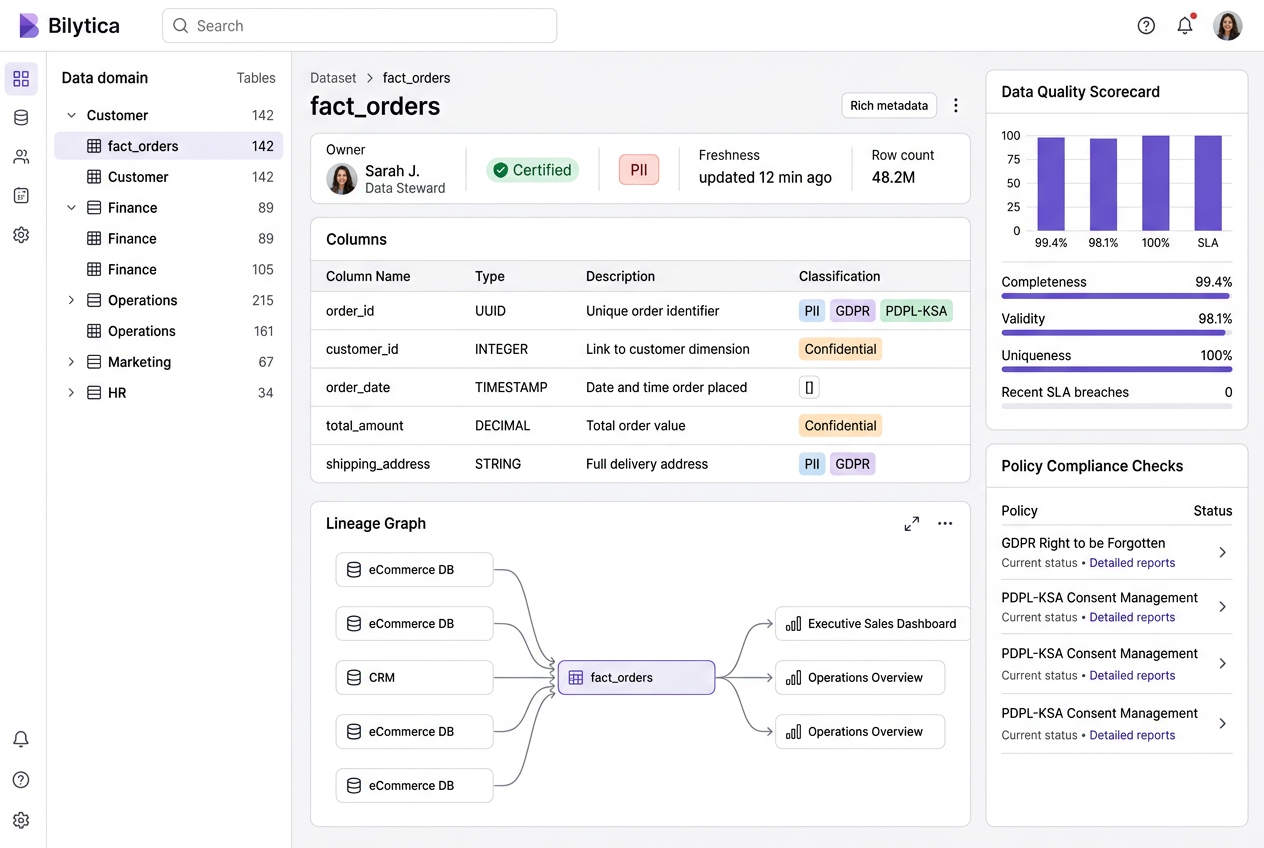
    Automated discovery, classification, and lineage tracking for every data asset. Know what you have, where it lives, who accesses it.

    Master Data Management

    Golden record creation, deduplication, matching, and survivorship rules. One version of truth for customers, products, and assets.

    Data Quality Framework

    Automated quality monitoring, profiling, and remediation. Data quality dashboards with SLA tracking and alerting.

    Platform Showcase

    A Glimpse of Our Work

    Dashboards and interfaces we've built for enterprise clients worldwide

    Data Governance: Catalog, Lineage & Compliance
    Click to enlarge

    Data Governance: Catalog, Lineage & Compliance

    Process

    How We Deliver

    From assessment to measurable ROI in weeks, not months

    01

    Compliance Assessment

    Gap analysis against NDMO, NCA, PDPL requirements. Detailed report with risk scoring and prioritized remediation.

    02

    Framework Design

    Design governance operating model, roles, policies, standards, and technology architecture.

    03

    Implementation

    Deploy governance tools, train data stewards, implement policies, and establish monitoring.

    04

    Audit & Certify

    Internal audit, remediation, documentation, and preparation for external regulatory review.

    Use Cases

    Deployed Across Industries

    Proven results in every major sector

    Government

    Ministry-wide NDMO compliance, cross-entity data sharing frameworks, and open data portals

    Banking

    SAMA regulatory compliance, data classification, and customer data protection under PDPL

    Healthcare

    Patient data governance, consent management, and cross-facility data sharing with privacy

    Energy

    Operational data governance for SCADA, IoT, and environmental compliance reporting

    Telecom

    CITC compliance, subscriber data protection, and CDR data governance

    Education

    Student data privacy, institutional research governance, and MoE reporting compliance

    Technologies & Platforms

    The platforms we build on

    Every platform here is a 2026 Gartner Magic Quadrant Leader or category standard, so your stack stays current, defensible, and future-proof.

    Governance Platforms

    CollibraCollibra
    AlationAlation
    I
    Informatica CDGC
    IBM Knowledge CatalogIBM Knowledge Catalog

    Catalog & Lineage

    Microsoft PurviewMicrosoft Purview
    AtlanAtlan
    DataHubDataHub
    OpenLineageOpenLineage

    Privacy & Consent

    OneTrustOneTrust
    BigIDBigID
    Securiti.aiSecuriti.ai
    TrustArcTrustArc

    Master Data Management

    I
    Informatica MDM
    SAP MDGSAP MDG
    ReltioReltio
    ProfiseeProfisee

    Data Quality & Observability

    I
    Informatica IDQ
    Great ExpectationsGreat Expectations
    Monte CarloMonte Carlo
    TalendTalend

    Saudi & Regional Compliance

    NDMO FrameworkNDMO Framework
    NCA ECC / CCCNCA ECC / CCC
    PDPLPDPL
    SAMA / SDAIASAMA / SDAIA
    How the work is structured

    How governance is operated

    Operated as a running function, with the artefacts an auditor asks for produced as a by-product.

    Register

    Data and system inventoryClassificationNamed owners

    Controls

    Lawful basis and consentAccess and maskingCross-border transfer records

    Evidence

    Lineage from source to reportQuality results over timeException and remediation log

    Assurance

    Model and use-case reviewPeriodic control testingReporting to the committee
    Selected work

    Work we have delivered

    Client identities are withheld. The situations, the build and the change afterwards are as they happened.

    Privacy operations

    A Saudi insurance group

    The situation
    Privacy work lived in legal opinions and slide decks with no operational record behind them.
    What we built
    A classification register, lawful-basis records and a transfer log maintained by the teams that own the data.
    What changed
    Requests for evidence are answered from the register instead of a document hunt.

    Data quality

    A public entity

    The situation
    Reported quality issues were discovered by the recipients of the report rather than the producers.
    What we built
    Automated quality checks at the point of ingestion with ownership routing and a remediation log.
    What changed
    Issues are caught and assigned before publication rather than after a complaint.

    AI use-case review

    A financial institution

    The situation
    AI use cases were approved case by case with no consistent basis for saying no.
    What we built
    A tiered review covering data, model, human oversight and monitoring, with a documented decision for each case.
    What changed
    Teams know in advance what will pass, and rejected cases carry a reason they can address.

    Where we are strongest

    We turn governance from a policy binder into a function that runs.

    Evidence as a by-product

    Registers, lineage and remediation logs are produced by the way the work runs, not assembled before an audit.

    Owners with real authority

    Accountability is placed with the teams that can change the data, which is the difference between a policy and a control.

    Built for regulated review

    Classification, consent handling and transfer controls are structured around what supervisors and auditors actually request.

    Assurance that scales with AI

    Model review, oversight and monitoring extend the same control set rather than creating a parallel governance track.

    Inspiring Case Study

    Transformed Government Digital Authority with Analytics

    Featured Success Story
    “Bilytica took us from partial regulatory compliance to full compliance quickly. They implemented cataloging, lineage, and classification across hundreds of datasets. We passed the audit on the first attempt.”
    Government Digital Authority
    Government: GCC Region
    Full compliance achieved
    SDAIA AlignedVision 2030PDPL · NDMONCA ECCSAMA Ready

    Built for Vision 2030, AI the Kingdom's regulators recognize.

    Every Bilytica AI solution is engineered for the Saudi governance stack: SDAIA Generative AI controls, PDPL data-subject rights supervised by the NDMO, NCA ECC cybersecurity, and sector frameworks from SAMA, CST, MoH and Etimad. Workloads stay inside Saudi data borders on STC Cloud, Mobily, Oracle KSA or Microsoft Saudi regions, with evidence packs ready for audit on demand.

    SDAIA AI Society partner
    Aligned with the National Strategy for Data & AI led by SDAIA, Generative AI guidelines applied to every deployment.
    Vision 2030
    Built around Vision 2030 priorities: digital government, sovereign cloud, Saudization of AI talent and an in-Kingdom data economy.
    PDPL · NDMO
    Personal Data Protection Law controls supervised by the NDMO, data-subject rights, lineage and DPIAs ready out of the box.
    NCA ECC + SAMA
    Essential Cybersecurity Controls from the NCA plus SAMA cyber + outsourcing frameworks, evidence packs generated continuously.
    From live tenders

    What buyers are asking us

    The questions that come up in almost every vendor evaluation, answered straight.

    “Who should own NDMO and PDPL compliance internally?”

    One accountable executive with authority over both IT and business data stewards, not a committee. Where these programmes stall, it is almost always because legal, IT and the business each believe someone else owns the decision.

    “Purview or Unity Catalog?”

    Fabric and Azure estates default to Purview; Databricks estates get deeper lineage from Unity Catalog. Neither covers the enterprise-wide business glossary and stewardship workflow well, which is why larger organisations end up running a catalog plus a governance tool rather than one of them.

    “Does mapping to NDMO domains actually improve data quality?”

    Done properly, yes, it forces ownership, quality thresholds and lineage that most organisations lack regardless of regulation. Done as a checkbox, it changes nothing. The tell is whether classification and quality metrics appear in anyone's objectives six months later.

    “What exactly are our cross-border transfer obligations?”

    That needs a current review against the authority's published guidance with qualified local counsel, the rules have been evolving and guessing here is genuinely dangerous. What we can do is architect so the answer is enforced at the gateway rather than trusted to a policy document.

    “How long does a real classification exercise take?”

    Six to twelve months for a credible first pass across critical systems, not the six to eight weeks that appears in most proposals. The constraint is business-side data-owner availability, and no tool shortens it.

    “Do we need a governance platform, or can we start with what we have?”

    For a first year focused on critical domains, lightweight tooling plus real process discipline works. Buying an enterprise catalog before you have an accountable owner just relocates the spreadsheet problem into something expensive nobody maintains.

    FAQ

    Frequently Asked Questions

    Common questions about Audits become fire drills., GDPR, PDPL & sector compliance on autopilot, every day..

    What does NDMO compliance actually require?

    Saudi Arabia's National Data Management Office mandates 15 data management domains, classification, cataloging, quality, sharing, open data, lifecycle, lineage and more. Most enterprises hit Level 3 (Defined) inside 12–16 weeks of structured work; we have a pre-built operating model and toolkit that compresses the timeline materially.

    How does this map to PDPL, GDPR and other privacy laws?

    Our governance framework covers Saudi PDPL, EU GDPR, UK Data Protection Act, US state privacy (CCPA, CPRA), HIPAA and sector rules (SAMA, NCA, CITC, MoH). One operating model, one catalog, one consent and DSAR engine, re-used across every jurisdiction you operate in. No separate programmes.

    Which Gartner 2026 Leaders do you deploy?

    We're certified on Collibra, Alation, Informatica CDGC, IBM Knowledge Catalog and Microsoft Purview, all 2026 Magic Quadrant Leaders. For privacy and consent we deploy OneTrust, BigID and Securiti.ai. Choice is driven by your existing estate, not a vendor partnership.

    How do you make compliance audit-ready every day, not just at year-end?

    Every policy maps to automated controls, PII discovery runs continuously, lineage updates with every pipeline change, access reviews fire on a schedule, evidence is captured in the catalog. When the regulator arrives, the evidence pack is one export away, not a 6-week scramble.

    Who owns governance once you leave?

    We design a steward operating model with named domain owners, a federated council, and a RACI that survives turnover. Stewards are trained, certified and equipped with playbooks. Many clients move to a managed-service model with us for the first 12 months, then run it themselves.

    What's the cost of doing nothing?

    PDPL penalties go up to SAR 5M per incident. Saudi government RFPs increasingly require demonstrated NDMO maturity, losing one large contract typically dwarfs the entire governance programme cost. And every AI initiative without governance gets blocked by legal at production cutover. Governance is the cheapest insurance you'll buy this year.
    Get a Free NDMO/NCA Compliance Assessment

    Our governance experts will assess your current compliance posture, identify gaps, and deliver a prioritized 90-day roadmap, at no cost.

    Call +966 54 597 3047

    🔒 No obligation · Free assessment · Results in 2 weeks